The ground above your drain field is not supposed to be soft, wet, or green in a suspiciously perfect strip. When it is, septic drain field problems have already progressed past the early stage, the one where a straightforward septic drain field repair was still the cheapest option on the table. Ignore it long enough, and you are not looking at a repair anymore. You are looking at a full drain field replacement, a contaminated yard, and sewage backing up into your home.
Crews Environmental helps Southwest Florida homeowners get ahead of that outcome before it becomes unavoidable.
In this blog, we talk about exactly why a drain field fails, how to see the early warning signs, what your repair options actually look like, and how to prevent it from happening again. The knowledge you need to make better decisions quicker, and nothing else.
What Is a Drain Field and Why Does It Fail in the First Place?
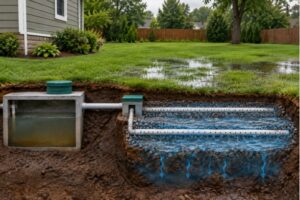
The drain field is the final stage of your septic system. Perforated pipes are placed in gravel-filled trenches, through which liquid effluent leaves the tank. The surrounding soil absorbs and filters that effluent before it reaches groundwater. When that soil can no longer absorb, the entire system backs up.
1. The Soil Is the System
This is what most homeowners miss: the pipes are not the drain field, the soil is. When septic system soil saturation occurs, no amount of pipe repair restores function. The soil has lost its permeability, and until that is fixed, there is nowhere for wastewater to go.
2. Why Florida Properties Are Especially Vulnerable
Southwest Florida’s water table sits unusually high. The field is often already saturated from a long run of heavy rain before any effluent even hits it. Heavy rain septic drain field problems are not rare here; they are a recurring reality that makes proper system design and maintenance non-negotiable.
How to Tell If Your Soggy Yard Is Actually a Failing Drain Field
A soggy drain field is one symptom. But taken alone, it is easy to dismiss as poor yard drainage. These signs together paint a clearer picture:
- Standing water over the drain field persists for days after rain.
- Unusually lush, bright green grass growing in a distinct strip over the field lines.
- Sewage odors in the yard, not just near the tank lid, but across the field area.
- A slow-draining septic system indoors, toilets gurgling, and drains sluggish across multiple fixtures.
- Septic backup problems, such as sewage surfacing in sinks or showers.
When more than two of these are happening simultaneously, the drain field is not just stressed; it is failing.
A slow drain today is a sewage backup tomorrow. The window between “manageable” and “emergency” is shorter than most homeowners think.
The Most Common Causes of Drain Field Damage Homeowners Overlook
Saturated drain field causes are not always dramatic. Most of the time, it is an accumulation of small, avoidable mistakes.
1. Biomat Buildup
Over time, a biological layer develops on the walls of the trench of each drain field. Managed properly through regular pump-outs, this layer stays thin. If the pump-outs are missed, solids spill over from the tank to the field and fuel the biomat growth until it completely closes off absorption, one of the most common water absorption issues experienced with older systems.
2. Root Intrusion
Root intrusion in drain fields is destructive and often invisible until a line is opened. Roots from ornamental trees, palms, and even lawn shrubs get into perforated pipes and slowly crack and clog them from the inside.
3.Water Overload
Running multiple laundry loads back-to-back, filling large bathtubs, or having guests significantly increases water volume. Septic system water overload pushes more liquid into the field than the soil can process, accelerating septic system soil saturation in the process.
Overlooked Cause | What It Damages |
| Skipped pump-outs | Soil absorption layer (permanent) |
Root intrusion | Perforated pipes |
| Vehicle traffic over the field | Pipe structure and soil compaction |
Excess grease entering the system | Tank baffles and field line openings |
| Water overload | Soil permeability |
Repair Options for a Damaged Drain Field, From Quick Fixes to Full Replacement
Not every septic system drain field situation calls for excavation. The correct way depends solely upon the cause of the failure, which is why the first step always is to make a proper diagnosis before coming up with any recommendation.
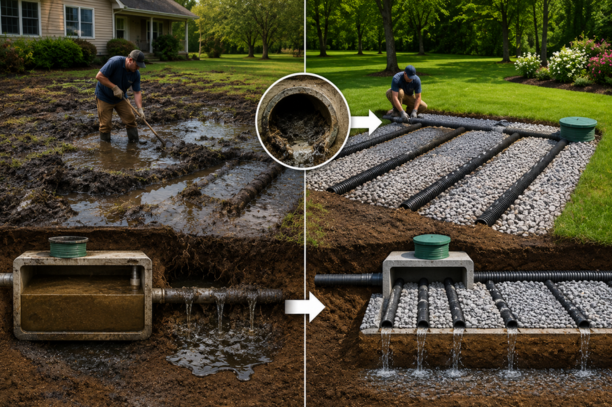
Hydrojetting clears clogged drain field lines caused by biomat or root debris without breaking ground. Partial pipe replacement works when damage is isolated to one section. Aeration or soil fracturing can sometimes restore permeability to a mildly saturated field.
x becomes unavoidable when the soil itself is the problem, when saturation and biomat damage are too advanced to reverse. At that point, the only option is to put a new field somewhere else on the property.
Think of a failing drain field like a clogged artery; you can address symptoms, but if the blockage is total, the structure needs to be rebuilt, not just cleared.
What the Drain Field Restoration Process Looks Like Step by Step
Failing drain field repair follows a specific sequence for a reason. Skipping steps leads to repeated failures.
- Tank pumping to relieve system pressure.
- Camera inspection and on-site probing to find exactly where the system is breaking down.
- Diagnosing what drove the failure, because treating symptoms without finding the cause guarantees a repeat.
- Repair or full replacement is carried out based on what the diagnosis actually reveals, not assumptions.
- Soil evaluation to determine if replacement is needed, to confirm alternate area viability.
- Post-repair system check before backfilling.
Crews Environmental team will walk homeowners through each step before work begins. Every proposal spells out exactly what is being done and why, no surprises.
How to Protect Your Drain Field from Future Damage
Preventing drain field collapse is significantly more straightforward than repairing one. These drain field maintenance tips directly extend the life of your system:
- Pump your septic tank every 2–3 years. This is the most impactful single habit.
- Keep vehicles, heavy equipment, and deep-rooted plantings off the field area.
- Spread laundry loads across the week rather than running them all in one day.
- Never flush wipes, grease, or harsh chemicals; they accelerate wastewater absorption issues.
- Divert roof runoff and surface water away from the field, especially during Florida’s rainy season.
Septic tank and drain field maintenance are inseparable. Neglecting one always catches up with the other.
When Soggy Becomes a Real Problem: Final Thoughts on Drain Field Health
Septic system drain field issues rarely resolve on their own; they worsen at a pace most homeowners underestimate. A soggy drain field that goes unaddressed leads to complete septic drain field failure, septic backup problems indoors, soil contamination, and eventually full drain field replacement at significant expense. Acting on early septic drain field failure signs is the decision that separates a manageable repair from a major project.
Crews Environmental has provided professional drain field services across Southwest Florida for over 40 years, serving homeowners in San Carlos Park, Lehigh Acres, Bonita Springs, Fort Myers, North Cape Coral, Captiva, and Naples. We are certified, licensed, locally owned, and available 24 hours a day, 365 days a year. Whether the situation calls for a targeted septic drain field repair or a complete system evaluation, our team gives you a straight answer and a clear scope of work before anything is touched.
Do not wait until the yard smells or the drains stop working. Call Crews Environmental today at 239-299-8604. We are ready when you need us.
FAQs
1. Can a damaged drain field be repaired, or does it always need full replacement?
Replacement is not always the answer. A lot depends on what caused the failure and how far it has progressed. Septic drain field problems caught early, such as biomat buildup, a cracked pipe, and minor root intrusion, are often fixable without touching the rest of the field. Drain field replacement only enters the conversation when the soil itself has lost its ability to absorb, and no repair can change that.
2. How long does a drain field repair typically take?
There is no single answer here because no two systems fail the same way. Targeted septic drain field repair work, clearing clogged drain field lines, and replacing a damaged section, is usually wrapped up within a day. A full replacement is a bigger undertaking and may run several days, depending on the system size and what the site requires.
3. What does standing water over the drain field actually mean?
It means the soil underneath is overwhelmed. Effluent leaving the tank has nowhere to go, so it pushes upward instead of filtering down. Standing water over the drain field is one of the clearest septic drain field failure signs you will see, and at that stage, septic system soil saturation is already well underway. The longer that water sits, the harder recovery becomes.
4. Can I use my plumbing during repairs?
It depends on the scope of the work. For minor repairs, light use is generally fine. During more involved work, your technician will walk you through what is safe and what is not. As a general rule, the less water entering the system during any repair window, the better the outcome.
5. Does homeowner’s insurance cover drain field damage?
Some policies cover sudden accidental damage. Gradual failure from neglect is rarely covered. Review your policy and contact your provider. We provide thorough documentation to support any claim.
6. How long does a properly repaired drain field last?
With consistent septic tank and drain field maintenance, a repaired field can last 20–30 years or more.
7. What mistakes accelerate failure after a repair?
Skipping pump-outs, planting near the field, parking vehicles over it, and high water usage too soon after repair are the most common. Root intrusion in drain fields is also a recurring issue when landscaping is not managed carefully.
8. What are the first signs of a failing drain field?
A slow-draining septic system, foul yard odors, and standing water over the drain field are typically the earliest and most ignored septic drain field failure signs.