Every commercial kitchen has that one “smart” habit passed down from chef to chef, shift to shift: pour hot water down the drain to flush the grease away. It seems to be working. But this routine is quietly ruining drain lines, filling grease traps to the brim, and getting kitchens ready for shutdowns that they never see coming. If your team is still doing this, the damage has likely already started.
Crews Environmental has spent 40 years pulling out the consequences of this exact mistake from commercial kitchens across Florida, and we’re here to explain what nobody else is making clear enough.
This blog breaks down the science behind the hot water flushes grease myth, what it does to your plumbing system over time, the grease trap maintenance mistakes kitchens keep repeating, and what real grease trap maintenance looks like before emergency mode forces your hand.
Where Did This Myth Come From?
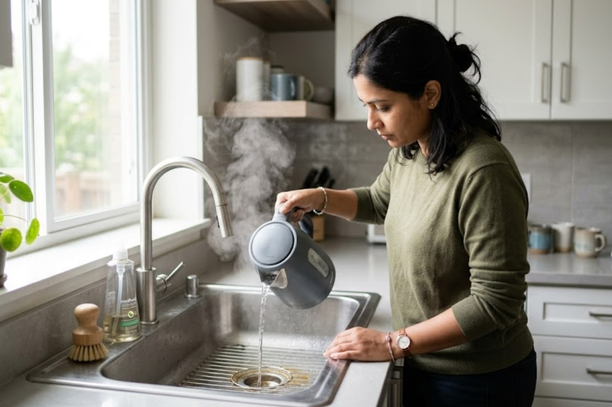
It started in the home kitchen. It is true that hot water melts grease. But “melts” doesn’t mean “gets rid of.” It means that grease turns into a liquid for a short time so it can move. Dish soap reinforced the illusion by making grease appear to vanish. When this habit migrated into commercial settings, the scale of damage multiplied fast.
The core problem is straightforward: hot water keeps grease mobile only while it remains hot. When the water cools down inside your pipes, which happens within the first few feet, the grease clings to the pipe walls again. Do this twice a day, five days a week, and you are not flushing grease away. You are painting your pipes with it.
The Science: What Hot Water Actually Does to Grease
FOG: fats, oils, and grease, act in a certain way. At high temperatures, it flows. Below approximately 40°C, it solidifies. Your drain pipes are not insulated, and in any commercial kitchen grease trap Florida environment, pipe temperature drops rapidly beyond the first few feet of the line.
Over months, grease buildup in pipes accumulates into dense, layered deposits that constrict flow. In the worst cases, this turns into a fatberg, which is a solid, unmovable mass of grease, food solids, and debris that has formed inside the line. Fatberg formation is not a hypothetical. It is what happens when this myth goes unchallenged long enough.
What the Inside of Your Pipe Actually Looks Like
Most kitchen managers have never seen a grease-clogged pipe up close. The inside looks like a tunnel that is getting smaller and smaller every week. There is thick, yellowed grease on every surface. By the time slow drainage is noticeable, you are already deep into a blockage process that ends in a full commercial kitchen drain clog and an emergency call.
If your drains still appear to be working fine, that is exactly when the damage is hardest to see and easiest to ignore.
The Real Damage: What Happens Inside Your Pipes
Grease buildup in pipes progresses in stages, and the first stage is completely symptom-free.
Stage | What’s Happening | What You Notice |
| Stage 1 | Thin grease film coats pipe walls | Nothing; drains run normally |
Stage 2 | Layers accumulate | Slight slowdown during heavy use |
| Stage 3 | Significant restriction forms | Backups during peak service |
Stage 4 | Full blockage or overflow | Emergency shutdown, regulatory risk |
Florida’s climate accelerates this timeline. Heat causes grease to cycle between liquid and semi-solid repeatedly, making deposits bond faster to pipe walls. Commercial kitchen drainage issues spike during the summer months in Florida, and kitchens that have neglected their traps routinely find out the hard way.
The Grease Trap Connection
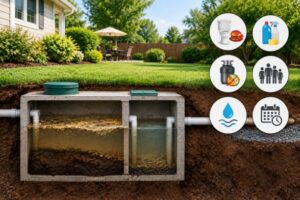
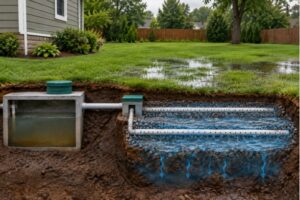
A grease interceptor is designed to catch FOG (fats, oils, and grease) buildup before it reaches the main sewer line. It works, but only up to a point. When hot water flushes grease in an emulsified, fast-moving state, it goes through the trap’s separation process too quickly to be kept. The trap lets it through, and from that point, the grease moves further into your drain lines and the municipal system, creating both a plumbing damage commercial kitchen situation and a wastewater compliance problem.
The Domino Effect Nobody Talks About
Grease trap overflow consequences go well beyond a foul smell. When a grease trap fails, drain lines back up, the kitchen shuts down mid-service, the health inspector is notified, and the violation gets documented. This chain moves faster than most operators expect. The cost of grease trap failure includes repair bills, lost service revenue, and fines under FOG regulations in Florida that are cumulative and escalating.
Grease trap overflow causes are almost always traced back to neglected grease trap maintenance and, consistently, the hot water myth.
Your grease trap has a capacity. Every skipped cleaning is a deposit toward a debt your kitchen will eventually be forced to pay.
What You Should Do Instead
Proper kitchen grease disposal starts at the source, not at the drain. These grease trap maintenance tips are non-negotiable for any kitchen that wants to stay compliant and operational:
- Scrape first, always. Every plate and pan should be scraped into a waste bin before washing. This single habit reduces your FOG fats, oils, and grease drain load more than any other action.
- Use dedicated grease collection containers. Cooking grease must be collected and disposed of properly, not rinsed away.
- Train staff consistently. Kitchen best practices for grease disposal need ongoing reinforcement, not just a one-time onboarding mention.
- Schedule regular grease trap pumping. Waiting for clogged grease trap signs means waiting too long. Prevention is the entire point of grease trap maintenance.
Understanding how to prevent grease trap backups is not complicated. It requires consistency that busy kitchens routinely let slip, and that slip is where common grease trap mistakes take root.
How Often Should Your Grease Trap Really Be Cleaned?
Most operators either follow a vague schedule every three months or wait until something smells bad. Neither approach is adequate, and both are among the most costly grease trap maintenance mistakes a kitchen can make.
The professional standard is the 25% Rule: Clean your trap when grease and solids make up 25% of its total capacity. At that threshold, trap efficiency drops sharply, and grease trap failure causes begin to stack. Grease trap cleaning frequency in Florida requirements vary by municipality, but the 25% rule applies regardless of local code.
Kitchen Type | Recommended Cleaning Frequency |
| High-volume restaurant | Every 4–6 weeks |
Café or lower-volume kitchen | Every 2–3 months |
| Food truck | Every 1–2 months |
School or institutional kitchen | Every 1–3 months |
Grease trap odor problems reaching the dining area are a late-stage symptom. At that point, the trap has been in need of service for a long time. Grease trap cleaning frequency should be driven by usage volume and the 25% threshold, not by smell.
Stop Letting a Myth Run Your Kitchen’s Plumbing
Decades of FOG fats, oils, and grease drain mismanagement have left commercial kitchens across the country dealing with preventable drain line blockage, failed wastewater compliance audits, and emergency calls that a maintenance schedule would have avoided. The hot water flushes grease myth persists because the damage it causes is invisible until it becomes a sewer backup restaurant situation, a grease trap pumping emergency, or a health violation that makes it onto the public record. Every time you pour greasy hot water down the drain, you’re slowly adding to a problem that your kitchen will have to deal with eventually.
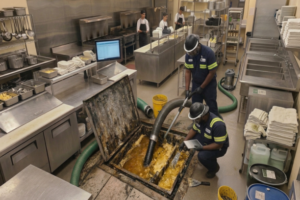
At Crews Environmental, we provide professional grease trap cleaning and grease trap pumping service to commercial kitchens across Fort Myers, Lehigh Acres, Bonita Springs, North Cape Coral, Captiva, Naples, and San Carlos Park, FL. With 40 years of hands-on experience, our team delivers reliable commercial grease trap cleaning, full grease interceptor servicing, and the compliance documentation your operation needs for FOG regulations in Florida, all with minimal disruption to your kitchen.
Schedule your service before a backup forces your hand. Call Crews Environmental at 239-329-8996, available 24 hours a day, 365 days a year.
FAQs
1. Does hot water really dissolve grease in drains?
No. Hot water melts grease for a short time, but as it cools down inside the pipe, the grease hardens again on the walls of the pipe and builds up over time, which can cause big restaurant plumbing issues.
2. What is FOG, and why does it matter for restaurants?
FOG is short for fats, oils, and grease. The main reason for drain failures, grease trap overflows, and regulatory violations in commercial kitchens is the buildup of FOG (fats, oils, and grease).
3. How often should a commercial grease trap be cleaned in Florida?
Follow the 25% rule and schedule cleaning every 1–3 months, depending on volume. Grease trap cleaning frequency Florida requirements vary, consult a licensed provider for local compliance guidance.
4. What are the fines for grease trap violations in Florida?
Fines vary by location and violation severity. Repeated FOG regulations Florida violations escalate significantly and can result in forced operational closure.
5. Can dish soap prevent grease trap buildup?
No. Soap emulsifies grease temporarily, allowing FOG (fats, oils, and grease) buildup to pass through the grease interceptor and accumulate further down the line.
6. What is the 25% rule for grease traps?
The 25% rule states that a grease trap must be cleaned once grease and solids reach 25% of its total capacity, the professional benchmark for effective grease trap maintenance.
7. How do I know if my grease trap is full?
Clogged grease trap signs include slow drains, grease trap odor problems, gurgling sounds, and mid-service backups. Contact a professional grease trap cleaning service right away if any of these appear.