There is a particular kind of dread that every restaurant owner in Fort Myers knows, even if they have never put it into words. It is not the fear of a bad review or a slow Tuesday night. It is the moment mid-service when something in the kitchen goes wrong, and you can tell from the look on your prep cook’s face that it is not a quick fix. The sinks are backing up. The floor drains are overwhelmed. And that smell: thick, unmistakable, completely out of place, is already making its way toward a dining room full of paying guests.
Three days ago, it was just a slow drain. You figured it could wait.
For restaurant owners across Fort Myers, Bonita Springs, Naples, Captiva, North Cape Coral, Lehigh Acres, and San Carlos Park, this scenario plays out far more often than it should. The frustrating truth? Nearly every grease trap problem of this magnitude announces itself well in advance. The warning signs are easy to spot if you know what to look for.
In this blog post, we break down the most common grease trap warning signs that commercial kitchens across Southwest Florida tend to overlook, and what happens when those signs are ignored long enough to become a real problem.
Why Slow Drains Are the First Sign of Trouble
A sink drainage slowdown is not a minor inconvenience you can push to next week’s maintenance list. In a commercial kitchen, it is almost always the first signal that your grease trap maintenance schedule has fallen behind.
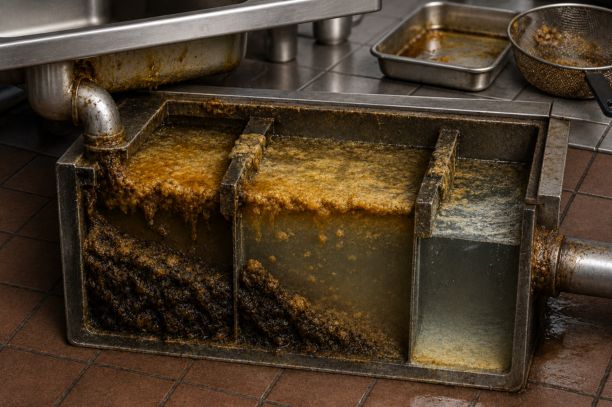
Here is what is actually happening beneath the surface. Grease traps are designed to intercept fat, oil, and grease buildup (FOG) before it enters the municipal wastewater system. As warm cooking oils flow through the interceptor, grease floats to the top while heavier solids settle at the bottom. When that middle layer accumulates, wastewater flow slows, and so does everything in your kitchen.
According to the U.S. Environmental Protection Agency, FOG is responsible for nearly 47 percent of all reported sewer overflow incidents in the country.
Quick Tip: If drainage slows during peak service hours, specifically, the issue is almost certainly inside the grease trap, not a debris clog in the individual drain.
What’s Really Building Up Inside Your Grease Trap
Most kitchen managers never look inside a grease trap. If they did, service calls would be scheduled far more proactively. Over time, three distinct and problematic layers develop:
Grease Trap Layer | What It Contains | Why It Matters |
| Top Layer | Floating oils and solidified grease | Directly restricts kitchen wastewater flow |
Middle Layer | Liquid wastewater | Carries grease downstream if the top layer overflows |
| Bottom Layer | Food solids and debris | Contributes to pipe obstruction issues over time |
Grease solidification is what makes this especially damaging. Oils that enter the drain warm and liquid cool and harden against pipe walls, progressively narrowing the passage until a full drain line blockage forms. No amount of hot water reverses that process, and the longer it goes unaddressed, the more expensive the correction becomes.
Early Warning Signs Most Kitchens Overlook
Grease trap warning signs tend to appear gradually, which is precisely why so many kitchens dismiss them until the situation becomes critical. Watch for these indicators:
Warning Sign | What It Likely Means |
| Persistent foul odors in kitchen drains | Decomposing FOG accumulating inside the interceptor |
Gurgling sounds near sinks | Air trapped by a developing blockage |
| Water pooling near floor drains | A plumbing system backup is already underway |
Grease residue near drain fixtures | System overload or early overflow |
| Recurring slow drains after busy service | Trap approaching capacity |
Southwest Florida kitchens face an additional challenge. Communities like Captiva, Naples, and Bonita Springs experience significant seasonal tourism surges, and the volume spike in food preparation during those periods can accelerate fat, oil, and grease buildup far faster than operators anticipate. A preventative maintenance schedule that works during quieter months may be entirely insufficient during peak season.
How Small Grease Issues Turn Into Major Shutdowns
Most kitchen shutdowns do not happen without warning. They happened because the warnings had been there for weeks, yet the kitchen kept running. When grease trap problems go unaddressed long enough, accumulated buildup eventually migrates beyond the interceptor and into the surrounding drain lines, and once that happens, routine grease trap pumping is no longer the answer. The repair scope grows, the cost grows with it, and suddenly, you are managing a crisis instead of a maintenance call.
The progression tends to follow a familiar pattern:
- Stage 1 – The ignored slowdown: Sinks drain a little slower after the dinner rush. The kitchen is still functional, so the issue gets moved to next week’s list.
- Stage 2 – Buildup spreads: FOG travels beyond the trap into connected plumbing, and kitchen wastewater flow starts slowing at multiple stations, not just one.
- Stage 3 – Backups begin: Wastewater starts surfacing near floor drains and prep sinks. Parts of the kitchen have to stop operating mid-service to manage it.
- Stage 4 – Compliance becomes a concern: Florida’s wastewater regulations do not make allowances for a busy season. A neglected grease trap can attract inspection concerns, sanitation flags, and, in the worst cases, a temporary closure order.
- Stage 5 – Emergency mode: What a scheduled commercial kitchen maintenance visit would have cost a fraction of what it does now requires urgent intervention, after-hours labor rates, and days of disruption to recover from.
The U.S. Small Business Administration has noted that sudden operational disruptions are among the top financial risks for food service businesses. In many cases, the distance between Stage 1 and Stage 5 is no more than a few weeks.
The Hidden Costs of Ignoring Grease Trap Problems
When kitchen managers think about grease trap problems, they usually picture the emergency plumbing bill. That number is real, but it is rarely the biggest hit. The costs that do the most damage tend not to appear on an invoice.
What Gets Skipped | What It Ends Up Costing |
| Routine grease trap cleaning | Emergency repair fees that dwarf any scheduled service cost |
Regular interceptor tank cleaning | Pipe damage that requires partial or full plumbing replacement |
| Scheduled grease trap pumping | Revenue lost across an entire evening or more of unplanned closure |
Consistent restaurant kitchen compliance reviews | Health inspection follow-ups, reinspection fees, and potential penalties |
| Proactive grease trap maintenance | Customer-facing reputation damage that outlasts the repair itself |
Think about what a single shutdown during the height of tourist season in Naples or Captiva actually looks like for a restaurant owner: a packed dining room that has to be turned away, an emergency crew brought in at after-hours rates, and reviews written in frustration that stick around long after the drain is running clean again. Set that against the straightforward, predictable cost of scheduled restaurant grease-trap cleaning, and the decision is not complicated.
Kitchens that keep up with regular interceptor tank cleaning spend less over time, and more importantly, they spend it on their own schedule rather than in the middle of their busiest night of the week.
How Routine Cleaning Keeps Your Kitchen Running Smoothly
The commercial kitchens that rarely experience grease-related shutdowns treat grease trap maintenance as a scheduled operational priority, not a reactive expense. Compare the two approaches:
Preventative Maintenance | Emergency Situation |
| Predictable service scheduling | Unexpected operational downtime |
Cleaner kitchen wastewater flow | Severe drain line blockage |
| Lower repair costs overall | Expensive emergency call-out fees |
Stronger kitchen hygiene standards | Sanitation and compliance concerns |
| Reduced sewage backup risk | Potential temporary closure |
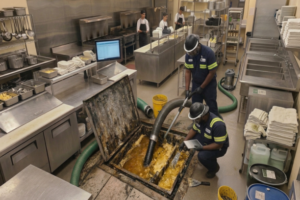
A professional commercial grease trap service visit typically covers grease layer removal, solid waste extraction, a system inspection, and a flow efficiency evaluation. For high-volume kitchens in Fort Myers, Lehigh Acres, North Cape Coral, and San Carlos Park, more frequent service intervals are often warranted, particularly during seasons when kitchen output increases substantially.
The Bottom Line: Grease Traps Warn You. The Question Is Whether You Listen.
Grease traps do not fail without warning. They send signals for weeks before the situation becomes critical, and recognizing those signals is what separates kitchens that stay operational from those facing avoidable shutdowns across Fort Myers, Bonita Springs, Naples, Captiva, North Cape Coral, San Carlos Park, and Lehigh Acres.
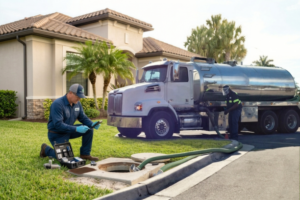
Crews Environmental has been serving Southwest Florida’s commercial and residential properties since 1982, offering grease trap pumping, cleaning and maintenance, septic services, drain field repair, septic inspections, and 24-hour emergency service throughout the region. If your kitchen is showing signs of drainage issues, contact our experts today at 239-332-1986 before a slow drain becomes a full-scale emergency.
FAQs
1. What are the early warning signs of a failing grease trap?
Slow drains, foul odors, gurgling sounds, standing water near floor drains, and grease residue around fixtures are the most common early indicators.
2. Why do slow drains indicate grease trap problems?
A sink drainage slowdown typically indicates restricted flow due to accumulated FOG and food solids, which limit wastewater passage through the trap.
3. How often should a grease trap be cleaned?
Frequency depends on kitchen volume, menu type, and seasonal demand. High-output commercial kitchens generally require more frequent service than lower-volume operations.
4. What happens if a grease trap is not cleaned regularly?
Neglect leads to severe blockages, plumbing backups, foul odors, increased risk of sewage backups, potential compliance concerns, and, in serious cases, full kitchen shutdowns.
5. Can a clogged grease trap cause a full kitchen shutdown?
Yes. When grease migrates into surrounding drain lines and causes a plumbing system backup, kitchen operations may be forced to halt entirely until emergency repairs are completed.
6. How do grease traps get clogged in the first place?
Fat, oil, and grease buildup accumulates faster than it is removed, eventually solidifying inside the trap and restricting normal wastewater flow.
7. What are the risks of ignoring slow kitchen drains?
Common consequences include pipe obstructions, drain line blockages, wastewater overflows, health code concerns, and significant emergency repair costs.
8. How quickly can grease buildup become a serious issue?
In busy kitchens during peak seasons, buildup can escalate from a manageable grease trap maintenance concern to a serious operational disruption within a matter of weeks.